The land is the ledger. This is a record of the work behind the idea. Films, field work, research, measurement frameworks, project proposals, screenings and conversations — documented as they developed.
A documentary following industrial hemp in the United States as prohibition began to lift. Directed, filmed and edited by Darryl J. Nicke II. Made and premiered in 2017; listed on IMDb in 2018.
It looked at what hemp could mean beyond the crop — agriculture, materials, energy, soil and regional economies.
CCS was founded on Earth Day as a carbon-farming company. Early pages described a product people might buy. Those pages are in the archive. Since then the work has centered on measurement, film and project design. We get there by the work, not by the name.
CCS entered the $100M XPRIZE Carbon Removal with WQ (Tokyo) — the WQ listing recorded the team as Qualified Competitor — and Jersey partners. The submission was a 100-hectare regenerative agri-solar carbon farm designed for dryland in Nyeri, Kenya: photosynthesis feeding living soil, solar sharing, water, and farmer payment from carbon markets — a thirty-year vision, not a farm we operated.
The competition did not award CCS a Milestone prize. The plan still shows what we were building toward: land as ledger, farmers paid to restore soil, energy as a companion to the crop rather than a replacement for it.
After the 2022 XPRIZE Carbon Removal entry, we still could not securely match counts of soil life to a carbon number. QSAAT was the tool we designed next: the same four groups a microscopist scores — bacteria, fungi, protozoa, nematodes — counted the same way each time.
We sat with Soil Food Web School on that problem. We looked at a ledger for the results. Neither became a product we sold. The gap is why we still say measurement, then value.
Developed in 2021, the method was filed as US application 18/098,564 on 18 January 2023. A related PCT application, filed 17 January 2024, was published as WO2024155705 on 25 July 2024. In May 2025 the inventors published an intent to abandon the US application and released the EHDC repository under CC0.
CCS operates no currency or market. QSAAT addresses measurement; EHDC is an open value-layer proposal. The repository contains experimental token code, not a deployed service.
A preprint proposing the Bio-Negentropic Capacity (BNC) scale. Kardashev classified civilizations by energy use; this paper classifies them by their measurable capacity to increase organized biological complexity.
It is a theoretical frame for “the land is the ledger,” not a validated measurement standard. Under its thresholds, modern industrial civilization is Type 0-Bio: ecological depletion exceeds regeneration.
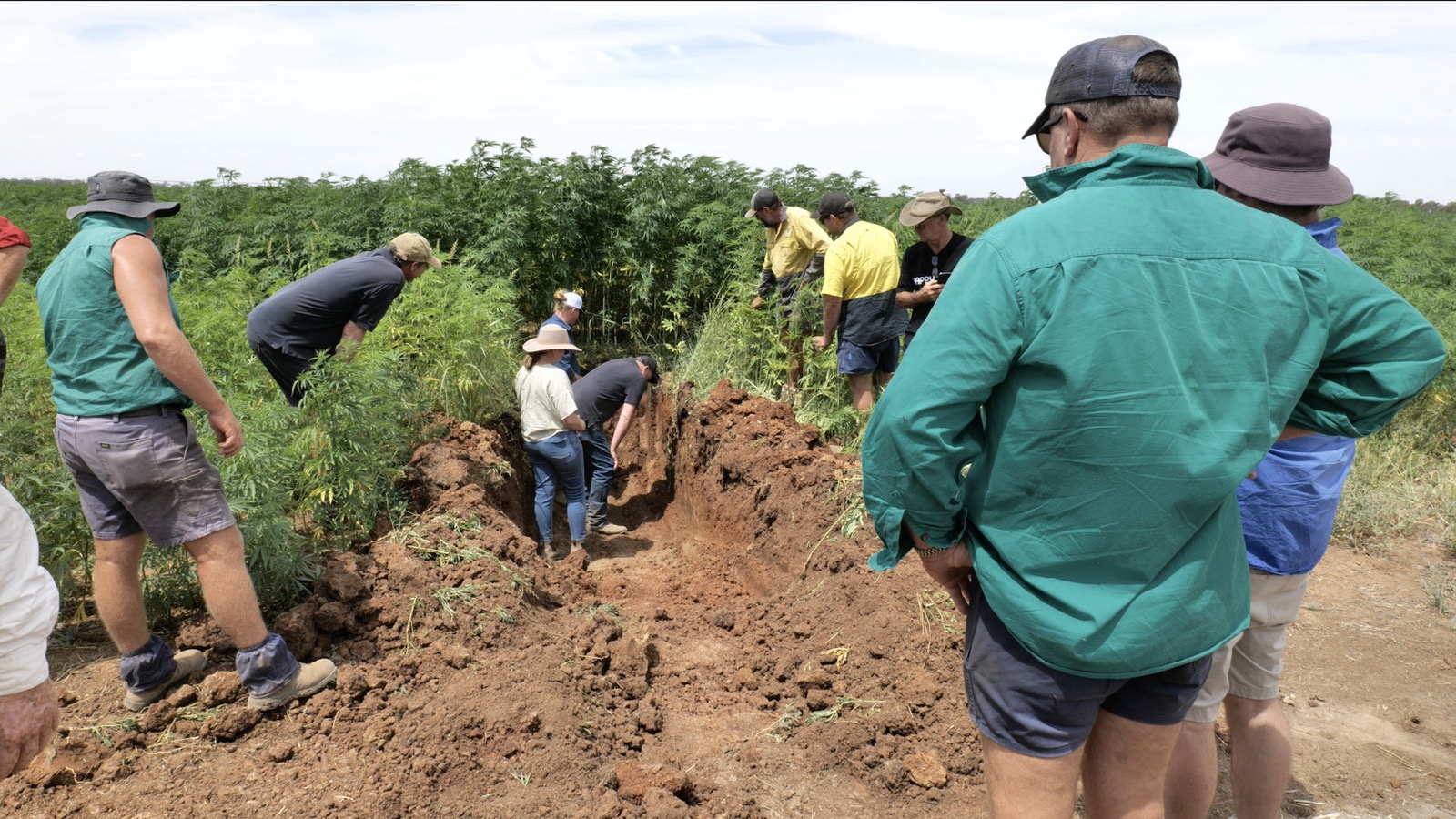
The Hemp Road Trip screened at the Edward River Council Town Hall. Growers, processors, and builders were in the room. The Deniliquin Pastoral Times covered the night as the first Australian screening of the film.
Nigel Lutton, general manager of the Pastoral Times, interviewed Darryl J. Nicke after the screening. They talked about what the plant can become, and why the mill should sit near the field.
A short film of hempcrete construction in Tocumwal, Australia. Zeitlos Media produced it. The builder speaks on camera. CCS filmed the wall; CCS did not build the building.
Crop and soil responses depend on place, management and time. Carbon storage must be measured rather than presumed. Measurement can support a method and contract; it does not create payment.