Australian farmers put thousands of tonnes of industrial hemp into bales, into sheds, into a market that had no reliable buyer waiting. The Senate spent a year asking why. It reported on 30 July 2026. The government now has three months to answer — and a documented habit of letting questions like this expire instead.
We were in the paddocks while the committee sat. We need to finish the road before the window shuts.
The next chapter of a story that began ten years ago
The Road Continues
Ten years after The Hemp Road Trip, we are getting back on the road. In 2017 we travelled the United States. Prohibition was still in force. The question was what hemp could become if the door opened. The film became a conversation — town halls, people imagining together — and the conversation kept going without us. In the UK, people who had seen it began investigating their own industry. That became Hemp: Eat Build Heal. 10 Days Abroad: Albania taught us not to follow one person.
We are not from Australia. We are here to make this film. In America we were asking whether hemp could become legal. In Australia it already is. Farmers grew it; some bales are still in the shed. We follow the crop — seed, farm, mill, maker, buyer — and the people trying to make each join work. Ten years ago we went looking for what hemp could become. Now we’re going to find out what it has become.
Seeds of Change: Just Add Water? · Directed by Darryl J. Nicke II · The crop leaves the farm; we follow it
The question
On 30 July 2026 the Senate Rural and Regional Affairs and Transport References Committee reported on Opportunities for the development of a hemp industry in Australia. Tim Schmidt — the Tasmanian farmer in the passenger seat — spent six years lobbying for that inquiry. The film was in the paddocks while the committee sat. The government still has to answer. The report.
We’ve got to get jobs and industry out of the cities and into the bush, where it can be done more effectively.
That is the geography of this film: a numbers guy leaves a high-rise; a bale still has to find a buyer in the bush. Hemp does not walk in as the answer. At the start there is nowhere for Mark Schilling to buy the seed. Mark says agronomic support was hard to find. On the MacDonald farm and at Tuppal Station we documented thousands of tonnes of baled hemp — grown into a market without a reliable Australian buyer. The inquiry’s own follow-on briefing puts the grower’s question as who is buying, not whether they can grow. Australian supply remains thin; imports fill parts of the gap.
The film is a series of tests. Can soil hold enough rain? Can a dryland farmer get seed? Can a bale find a mill — and a buyer — in this country? The road has to answer. Just Add Water? is the provocation, not a promise.
New South Wales’s 2026 hemp plan, as reported by HempToday, highlighted a large gap between hectares licensed to grow and land actually planted. Downstream markets and processing are what close it. Harrison Marsh of Living Canvas, a NSW hemp-panel maker awarded state co-investment: “More hemp in construction doesn’t just build better homes, it supports an emerging agricultural industry for NSW.” La Trobe’s Ernesto Valenzuela, on hempcrete: the urgent gaps are decortication and quality standardisation — “Reliable, well-scaled processing is essential to deliver consistent hurd quality for manufacturing.”
The Advertiser: Elden and Jake Oster — You can’t eat carbon
Yorke Peninsula, 2024. You can’t eat carbon.
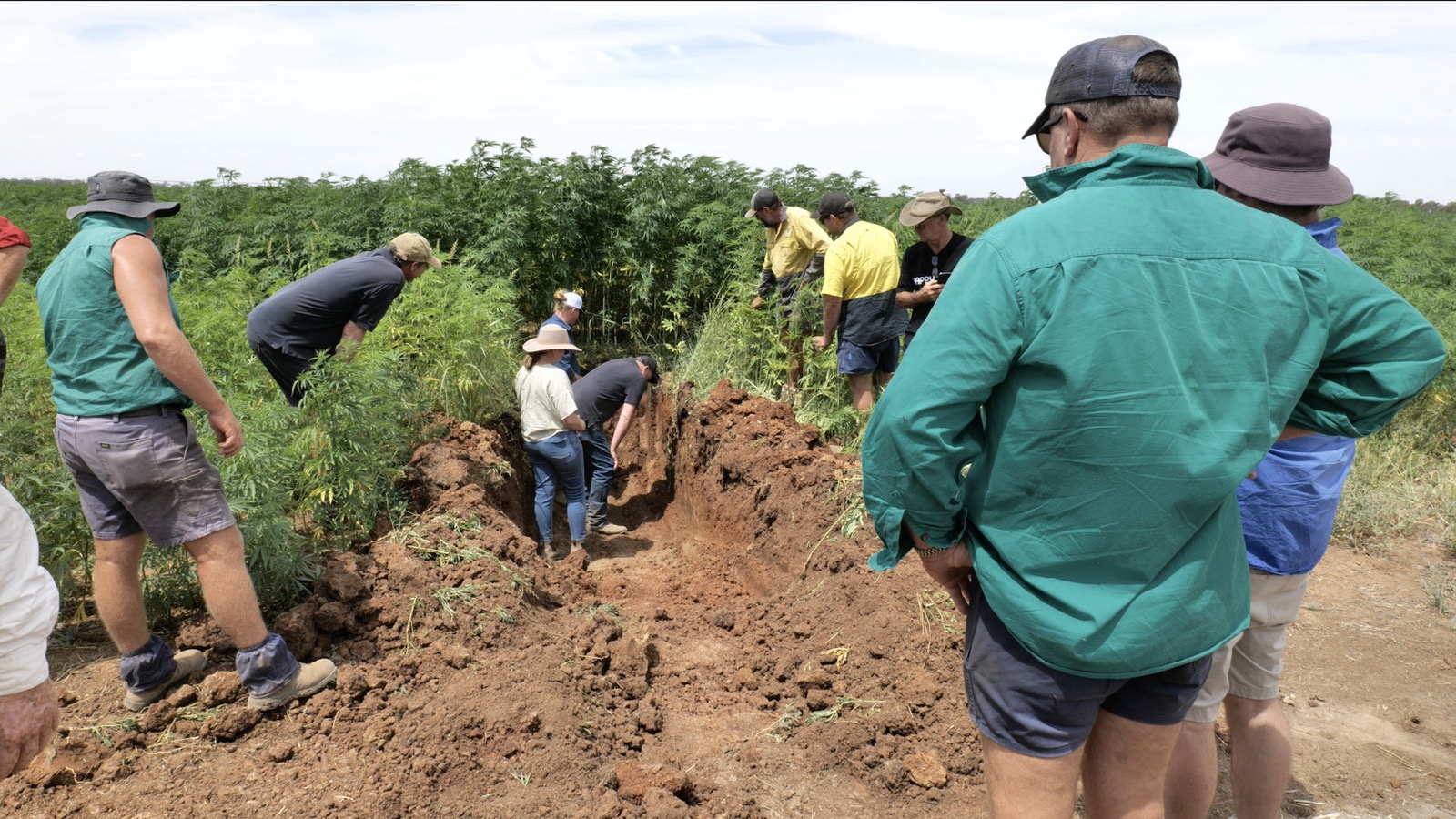
Soil pit under industrial hemp, Bruce MacDonald farm
Deniliquin, Feb 2025. Soil pit under hemp. Photo essay
Tocumwal hemp short
Tocumwal short — the model for stop-by-stop films.
People
We do not follow one person. The spine is the chain: seed, farmer, harvest, mill, maker, buyer. Each stage asks the next question. The people carry it — each gets a highlighted part, as in 10 Days Abroad: Albania.
Winton Evers is CCS’s carbon-accounting collaborator — EcoProfit, a Verra account holder. The film can open on him in a high-rise as the Senate report lands. He is not a stranger who wandered in. He leaves the office for the paddock.
Tim Schmidt is a Tasmanian hemp farmer and founding president of the Australian Hemp Council from 2020. He spent six years lobbying for the Senate inquiry. He is one chapter of the chain, not the whole film. He is eager to be on this road.
CCS is pursuing a regional hemp processing hub in Deniliquin, one of the towns this film covers. That is why we have the access. It is not a farm we operate.
The road
The committee called for processing infrastructure, plant breeding, hempcrete in the National Construction Code, and measurement of carbon in hemp construction. That is this route — and it matches what NSW has started to fund: mills and panels, not more unused licences. The window between a report and a government response is live now. Filmed stops show a still; planned stops stay text until there is a consented short or field note.
01 · Premise
Tasmania — Tim Schmidt
A hemp farmer’s life, and an industry he helped build in Tasmania from almost nothing. Seed is still hard to buy. A bale is still hard to sell. The tour starts where he lives the blockage — and where he spent years getting it onto the national record.
Planned
02 · Test
Yorke Peninsula — Mark Schilling, Elden Oster, John Muir
You can’t eat carbon. He is now running trials with John Muir, who is supplying the seed. The breeding question is Australian dryland hemp: stem, grain, or both — and whether the plant can do that without waiting on a northern day-length. Winton and Tim check in.
Oster / sanctuary filmed · hemp trials planned
03 · Test
Deniliquin — the MacDonald family, Tuppal Station
They grew it. The bales we documented — MacDonald farm and Tuppal Station — still have no reliable Australian buyer. Processing, not acreage, is the missing join. A path to market has to reach a farm.
New South Wales to Broome — Simon Crittenden and Liyan Foundation
Simon builds hemp panels in NSW and ships them to Broome for homes organised with Victor Hunter of Liyan Foundation, for an Aboriginal community. Filming that chapter depends on community consent. The Tocumwal short is the builder on camera; this is the builder at work, at distance.
Planned
05 · Reopens
Western Australia — hemp operations
Tim’s introductions. Broome does not close the question. Another coast, the same unanswered market — the test returns.
Planned
The shorts and the Senate
Each stop serves the feature and its community. With consent, one interview can become a short portrait, a few clips, and a field note published while the road continues. Participants receive useful material; audiences meet the film before release. The feature keeps the uncertainty. The shorts carry the Senate findings and practical questions into each town.
Teaser
2024 teaser
Stop model
Tocumwal hempcrete
Earlier method
The Hemp Road Trip, 2017
What exists
Footage from 2023–2025 on the Yorke Peninsula and at Deniliquin. Families on camera. A 2024 teaser. The Tocumwal short as the stop-by-stop model. There is no assembly cut yet. Shorts and field notes publish only after consent, and after the feature has what it needs. We do not put a percentage on a film still being found on the road.
Crowd: help the next chapter of the film. Finishing partners: terms stay off this page until you ask. Director: Darryl J. Nicke II. Backing the film does not fund the proposed Deniliquin hub, a farm, or carbon credits.