Work · 13 February 2025

What the soil pit showed

Bruce MacDonald’s farm. Industrial hemp. A trench through the stand. Dark soil thick under the crop, thinner at the edge — then the redder clay.

Depths are judged from hands, plants, and people in the trench — not a tape. Dark colour is what the eye sees, not a lab carbon number, and not a credit.

Soil pit under hemp: dark topsoil over redder clay, pale roots on the left
Under the hemp. Dark, living-looking soil from the surface down; then redder clay. Pale roots run through both. Most of the root mass sits in that dark layer. Finer roots keep going into the clay.
Hands on the dark soil face for scale
Hands for scale. An adult hand is about 18–20 cm. Both hands sit in the dark layer under the stand.
Redder clay face with fine white roots
Fine roots in the clay. White threads below the dark band. The roots are not only in the stained topsoil.

At the edge of the crop

The dark layer follows the hemp. Thick under the plants. Thin toward the open ground. Clay beyond.

Hand at the edge of the hemp stand: dark soil under plants, redder clay beyond
Boundary under the hand. Dark soil under the plants; redder clay in the cut beyond. Not a thin skin of mulch over pale ground.
Dark layer thick under denser hemp, thinning toward clay at the open edge
Same edge, wider face. Deep under denser stems; thinning toward the open edge.
Hemp plant held up, showing fibrous root mass
What a pull brings up. A fibrous mass on the plant. Deeper roots often snap. The pit face shows what stays in the ground.
Dense hemp stems with litter on the soil
Under the canopy. Dense stems, litter on the soil, little weed between the rows.
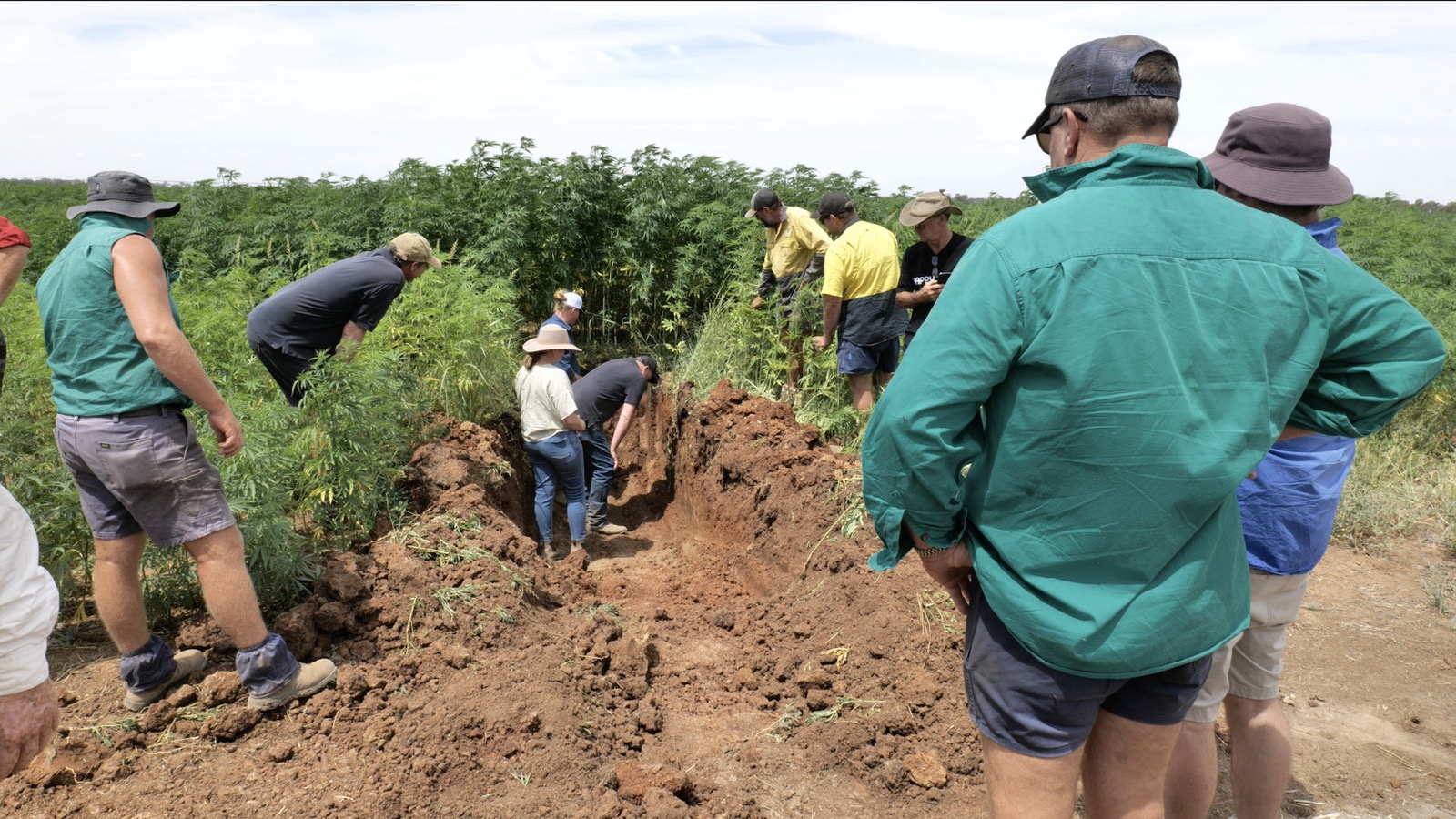
People standing and crouching in a trench through the hemp field
People in the cut. Standing and crouching in the trench — about waist to chest deep — reading the face in the field.

Back to Work